In this post
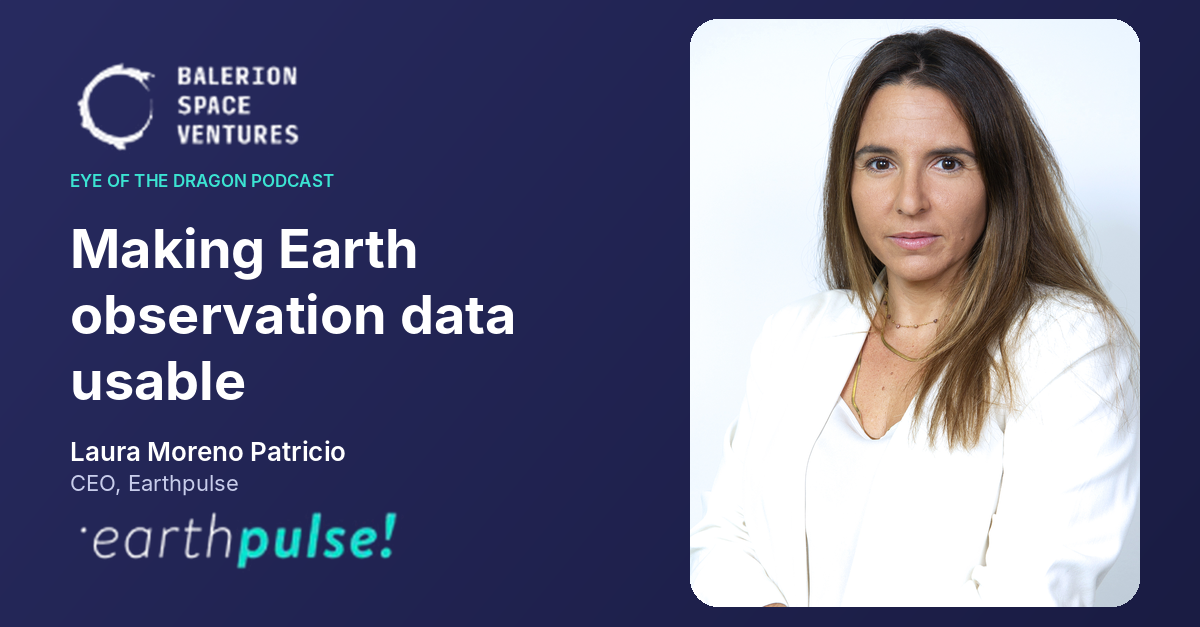
Every year, Earth observation satellites produce more and more data. Most of it is never used by the people who could benefit from it. In a recent episode of the Balerion podcast, our CEO Laura Moreno Patricio spoke with host Aidan Daoussis about how Earthpulse is closing that gap.
This post summarises the main ideas from the conversation. You can listen to the full episode for the details.
Lots of data, little use
Governments and companies have invested a great deal of money in building, launching and maintaining satellites and while the data from those satellites is available, there is a large gap between having the data and using it well.
Laura explained that Earth observation data is mostly used today by defence and scientific teams. These teams have specialists who know how to read it, and while many other organisations could benefit from the same data, they do not have those specialists. Earthpulse focuses on these non-expert users.
A product, not a consulting project
Laura said that most companies in this sector deliver their work as consulting projects. Each new project starts from zero. Earthpulse takes a different approach. It builds a product from modular blocks, which she compared to Lego.
Each client goes through a short integration phase. This takes about four weeks. During this phase, Earthpulse customises the solution and connects it to the client’s own systems and data. Earthpulse calls these solutions Pulses.
After that, the client can reuse the solution wherever they need it. For example, a road operator can deploy a landslide risk solution on one road in Brazil. Later, the operator can deploy the same solution in China, Africa or the United States. Each new deployment takes about five to ten minutes.
Using many data sources
Earthpulse does not rely on one satellite or one constellation. Laura said that a single satellite never solves a real problem. A flood, for example, is sometimes solved with one type of data. Often it needs a combination of several.
The company works with data from Sentinel and the European Space Agency, as well as commercial providers such as Planet and Maxar. It is also exploring a partnership with Umbra, which provides radar data. The platform decides which data a problem needs and builds the application from there. Laura described this as being able to “query the Earth”.
She also said that she does not share the view of satellite builders who turn to applications that only use their own data. Her view is that the value lies in combining as many data sources and algorithms as possible. The result should then be delivered in a form the user understands.
From information to action
Laura moved to talk about alerts and exaplained how on its own it has limited value. The client also needs to know what to do about it. For example, a road risk alert should link to a protocol, such as lowering the speed limit when risk rises.
Earthpulse has added this link between information and action over the last year. The client decides which actions to take. Over time, the client can see the effect, such as fewer accidents on a road after a year of acting on the alerts.
Large language models as an accelerator
Aidan asked how large language models have changed the sector. Laura said they have helped Earthpulse a great deal.
From the start, the company wanted users to be able to chat with the Earth and get answers. It began building its own language model. When general-purpose models arrived, the team could use them instead.
Laura also said that foundation models are the right base for algorithms that must work in different regions. They can then be retrained with local data to get the best performance.
Building a deep-tech company in Europe
The conversation also covered what it is like to build a space-tech company in Southern Europe. Laura said it is difficult. Investors often expect fast growth with low investment, which is hard for deep tech.
For its first years, Earthpulse used public funding to build, test and improve the product. Laura sees this as the right choice while a company is still searching for its market. Now that the product has traction, she sees it as the time to bring in private capital and grow faster.
She noted that more venture capital funds in Spain and Italy now look at deep tech. She also noted that culture differs between European and U.S. investors, and that the U.S. remains an option for later growth. For now, Earthpulse is focused on Europe and reaches other regions through partners such as Telefónica and Microsoft.
Listen to the full episode
The episode is available on the Balerion podcast: https://open.spotify.com/episode/0VvD0KljQEjW7632LDxedV?si=GLHoxTdfS9Czz25oh8a2hQ&nd=1&dlsi=cc3a111fa21e454f